Wrestling the PDF catalogue
As part of my current creative producer role at Open Eye Gallery, I am supporting three socially engaged artists and their groups to engage with work from the archive. This is a useful practice exercise as I learn to work with this resource in advance of my PhD research starting properly. The first stage of this has been to whittle around 2,000 images (plus some videos) down to something more manageable. I’m going to reflect on my experience of this process to date using Kolb’s Learning Cycle (1984).
The PDF catalogue we are using feels quite daunting to me due to its size – I would definitely struggle to do this alone so myself and two colleagues have made it a collaborative endeavour. The first thing we did was split the document into roughly equal parts. We decided our aim was to reach 60 images in total which will be shared with the photographers who we are supporting. They will then make their own selections, with their groups being shown their choice of around 25-30 physical prints when they visit the gallery.
Although this turns us into gatekeepers in a way, our intention is to be helpful by avoiding overwhelm, and adding the second stage gives the artists some power within the process. The challenge is that with no clear themes or subjects of interest emerging yet from the groups, which are only just getting going, we had to make quite an open selection which hopefully covers lots of bases. My pages were 1-585 (one image per page).
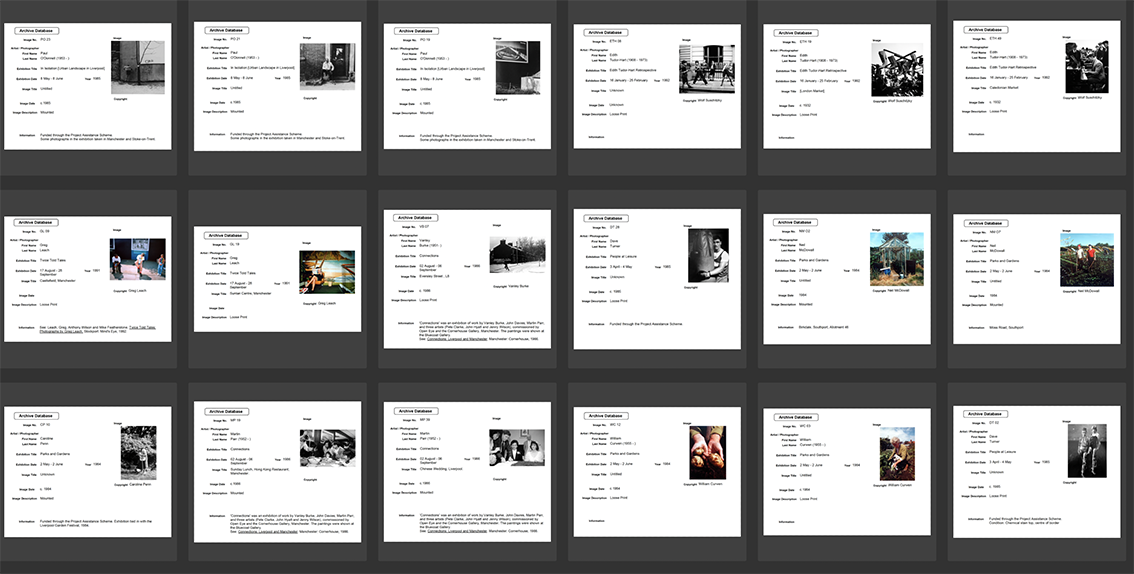
Some of my selection
The second stage of Kolb’s cycle is to review what we’ve done and how it felt. My initial approach was to look for individual images which jumped out at me. It felt a bit chaotic and I was conscious I was being very biased towards my own visual tastes – lots of bleak and gritty 1980s documentary, clever compositions and deadpan portraits and photographers whose work I know and admire.
I ended up junking this first selection and taking another look with a more open mind, thinking more about what kinds of images may resonate with people who are probably not educated in art or photography. There were some post-industrial urban landscape images which show a lot of degradation. There were some historic Edith Tudor-Hart images which show markets and kids playing and buskers. There was some colour street photography which is playful and interesting to look at, and a number of photos about allotments, gardens and parks. It’s an interesting process trying to separate out my own taste from what bases we might need to cover in a big commissioned socially engaged project, while also not prejudging how other people may react.
The third stage of Kola’s cycle is called ‘abstract conceptualisation’ - this is where the analysis is meant to happen. The three of us met to discuss how we were doing with the process – this open round table discussion informed the final selection method for me, as it helped me answer some questions and moved me forward with making my choices. I realised I had been thinking of my selection as an edit – seeing ‘my’ images as a defined set, from the perspective of a photo editor or curator ie feeling they needed to work together or balance out in some way. But through this conversation I realised this was not how to look at it. A colleague instead suggested thinking in a much broader way, and considering what people may be able to connect with. While also looking out for anything that could be hurtful or harmful, or which could signify something difficult to someone who may well have experienced some trauma (many have moved to the UK through the refugee system).
The final stage of Kolb’s cycle is active experimentation, where you put your learning into action. In this instance this was me going back through my section of the archive PDF once again. I went back through all the images I had previously discounted and put some back into my wide edit, which ended up even bigger than before. I realised – post group discussion – that some of my original selection are no longer even in the physical archive so needed binning from my set; I had not noticed a note saying the prints have been returned to the photographer. There is also a whole section of comedy-related images which are orphaned, with no listed photographer – again something I wanted to avoid.
In the end, the process of cutting down my selection from 50-odd to 20 was quite simple as a result of our discussions. There’s a mix of style, form, theme and image type. It will be interesting to see how the final 60 come together and what the artists and their groups gravitate towards.
Kolb, D.A. (1984). Experiential learning: experience as the source of learning and development. Englewood Cliffs, NJ: Prentice Hall